
Even as Pakistan continues to claim that India has not provided enough evidence in the Mumbai terror attack case, Interpol has suggested otherwise by issuing an arrest warrant against Jamaat-ud-Dawa chief Hafiz Saeed.

'Saeed has been freed as the government decided not to detain him in any other case,' a top Pakistan official told PTI.
India on Thursday asked Pakistan to demonstrate the same 'force' to deal with terror groups like Laskar-e-Tayiba and Jaish-e-Mohammed like it has done against the Taliban in Swat Valley.
India has said it would talk to Pakistan if it takes "credible steps" to demonstrate its willingness to fight terror both "within and without". External Affairs Minister S M Krishna, however, suggested that Pakistan had not done enough to bring to justice the perpetrators of Mumbai attacks and highlighted the release of Jamaat-ud-Dawa chief Hafiz Saeed as a case in point.
Mohammad Omar Madani's links to the 26/11 Mumbai attack and also other terror strikes in the country are getting more and more evident. The Delhi police and the Intelligence Bureau have been grilling Madani after he revealed that he had links with Hafiz Saeed, Abu Hamza, Sabahuddin and Fahim Ansari all of whom have were involved in the Mumbai terror attack.
The most wanted man in connection with the serial blasts, which had claimed 187 lives on July 11, 2006, is Lashkar-e-Tayiba operative Azam Cheema.Cheema, 57, is based at the Bahawalpur camp of the LeT in Pakistan. He has been given the charge of fomenting terror-related activities in Delhi and Mumbai, say sources in the Intelligence Bureau.
The arrest of Abdullah Omar Madani in New Delhi will help the police crack the financial code of the Lashkar-e-Tayiba, according sources in the Intelligence Bureau. Madani is reportedly a close aide of the LeT Hafiz Saeed and apart from handling recruitments in Nepal, Madani was also in charge of financial transactions in India.
The Obama administration is "disturbed" by the release of Jamaat-ud-Daawa chief Hafiz Mohammad Saeed, who was placed under house arrest nearly six months ago in the wake of the Mumbai attacks, US Special Representative Richard Holbrooke said on Wednesday.
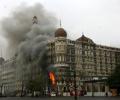
Pakistan on Saturday said the trial in the Mumbai attacks case would be carried forward based on the information brought by a judicial commission that had visited India recently.

Chinese state television CCTV9 has highlighted the role of the LeT and its sponsors in Pakistan in this horrific attack which shook the world.
"We believe Hafiz Muhammad Saeed, the LeT chief, is a khawarij (rebel) and needs to be punished under the law," secretary general of the Markazi Jamiat-e-Ahl-e-Hadees, Maulana Asghar Ali Imam Mehdi Salfi, said.

Mushtaq Ahmed Zargar, who was involved in a series of terror attacks in Jammu and Kashmir and was one of the released terrorists in the hijacking of Indian Airlines flight IC-814 in 1999, has been designated as a terrorist by the Union government.

The BJP on Wednesday strongly disapproved of its MP Adityanath's controversial comments comparing Shah Rukh Khan with Pakistani terrorist Hafiz Saeed.

The movie was banned on a plea filed by Jamaat-ud-Dawa chief and Mumbai attack mastermind Hafiz Saeed alleging that the film contains "filthy propaganda" against him and his outfit.

Jaishankar said: "Our expectation levels with the Pakistanis are never very high."
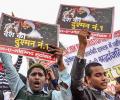
They are the first to be declared terrorists under the new anti-law, a home ministry official said.

Lashkar-e-Tayiba chief and 26/11 attacks mastermind Hafiz Muhammad Saeed has said that 2001 Parliament attack convict Afzal Guru was executed merely to satisfy the "ijtimai zameer" (collective conscious) of the Indian nation that can only be satisfied with blood.

Accusing Congress of playing "dirty politics" over the Pakistani boat issue, the Bharatiya Janata Party on Monday demanded that its vice president Rahul Gandhi clarify whether he supports his party leaders speaking Pakistan's language.
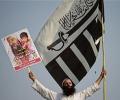
Tightening its noose around the Lashkar-e-Tayiba, the United States has added its affiliates, including the Jamaat-ud-Dawa, to its list of designated terror organisations and slapped sanctions against two Pakistan-based LeT leaders.
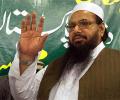
The UN decision came after India provided detailed evidence about Saeed's activities.
Jamaat-ud-Dawah chief Hafiz Mohammad Saeed's release has raised questions about the efficacy of Pakistan's campaign against terror and the adequacy of the country's legal framework for dealing with militant leaders, the Pakistani media said on Thursday.
"We are unhappy," said Home Minister P Chidambaram, reacting to Jamaat-ud-Dawa chief Hafiz Mohd Saeed's release by a court in Pakistan.
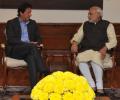
"It is not in our interest to allow use of Pakistan's territory for terror outside," Khan said.

The 30-member team includes 15 doctors and eye specialists.

However, the Pakistani-American LeT commander Zakiur Rehman Lakhvi stopped him, saying something more "adventurous" was in store for him.

Pakistan was put in the inglorious list in 2018 for its failure to check risk of money laundering, leading to corruption and terror financing.

Referring to Narendra Modi's speech targeting the prime minister on the Independence Day, Shiv Sena on Saturday said it hoped that the Bharatiya Janata Party leader, when he takes the top post, would "drag" fugitive gangster Dawood Ibrahim to India and hang him.
Jamaat-ud-Dawa chief Hafiz Mohammad Saeed, mastermind of the Mumbai attacks, today alleged that India has "imposed war on Pakistan" by constructing "illegal dams" and diverting water of Pakistani rivers and said the government must prepare the nation to counter this aggression.
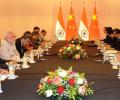
The Prime Ministers Office is upset that the Congress party was deliberately playing up the Saeed-Vaidik meeting in Parliament to detract attention from Prime Minister Narendra Modi's meeting with the Chinese president. Rediff.com contributor Renu Mittal reports
JuD chief and 26/11 mastermind Hafiz Saeed has alleged that United States wants to gain two objectives by announcing the $10 million bounty on his head, reports Tahir Ali
Pakistan plans to ban 10 terror outfits, including 26/11 mastermind Hafiz Saeed-led Jamaat-ud-Dawa and the dreaded Afghan-based Haqqani Network, a move seen by experts as a "paradigm shift" in the country's security policy in the wake of Peshawar school massacre.

The mandates which Pakistan has failed include action against all United Nations-designated terrorists like Jaish-e-Mohammed chief Azhar, Lashker-e-Tayiba founder Hafiz Saeed and the outfit's operational commander Zakiur Rehman Lakhvi.

Rajnath Singh's remarks in Parliament on July 31 have revived the debate on 'Hindu terrorism.' What do you think?
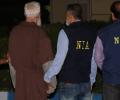
The National Investigation Agency (NIA) has begun questioning Tahawwur Hussain Rana, the mastermind behind the 2008 Mumbai terror attacks, to uncover the larger conspiracy behind the deadly strikes. Rana, who was extradited from the US, is being held at the NIA headquarters in New Delhi. The interrogation is focused on his possible connection with the Lashkar-e-Taiba (LeT) and his suspected links with the Pakistani spy agency Inter-Services Intelligence (ISI).
Tahawwur Hussain Rana, a Canadian national accused of involvement in the 2008 Mumbai terror attacks, has been extradited to India from the United States. Rana's interrogation is expected to shed light on the role of Pakistani state actors in the attacks, which claimed 166 lives. Indian authorities are particularly interested in his travels across India in the days leading up to the attacks, including visits to Hapur, Agra, Delhi, Kochi, Ahmedabad, and Mumbai. Rana's extradition follows a lengthy legal battle, with the US Supreme Court ultimately denying his application to challenge it. Rana is known to be associated with Pakistani-American terrorist David Coleman Headley, one of the main conspirators of the 26/11 attacks. The investigation into the Mumbai attacks has implicated senior members of terror outfits Lashkar-e-Taiba (LeT) and Harkat-ul Jihadi Islami (HuJI), as well as officials from Pakistan's Inter-Services Intelligence (ISI).
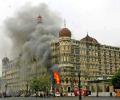
Tahawwur Rana, accused of involvement in the 2008 Mumbai terror attacks, is expected to be extradited to India from the United States soon. The US Supreme Court denied his last-ditch effort to stop his extradition, moving him closer to being handed over to Indian authorities. Rana's extradition is expected to help probe agencies expose the role of Pakistani state actors behind the attacks and shed new light on the investigation. He is associated with Pakistani-American terrorist David Coleman Headley, one of the main conspirators of the 26/11 attacks.
Continuing his anti-India rant, the chief of Jamaat-ud-Dawah Hafiz Muhammad Saeed, has now said that 'jihad' is the only way to free Jammu and Kashmir from the "Indian yoke". Saeed, who India blames for masterminding the 2008 Mumbai attacks, made the remarks while addressing a meeting of JuD workers at the Jamia Masjid Mukarram at Daska in Punjab province on Monday.
Prime Minister Narendra Modi on Monday said the upcoming assembly election is a fight between trust on development and dynastic politics.
Pakistan has not received any "solid evidence" against outlawed Jamaat-ud-Dawah chief Hafiz Mohammed Saeed from India so far, Foreign Minister Shah Mahmood Qureshi said on Friday, as New Delhi presented a fresh dossier on the26/11 carnage to Islamabad.
